
Larimer County Court Records After Arrest
After a Larimer County arrest, the public record path divides. The jail roster and booking report are Sheriff's Office records. They can show arrest location, arresting agency, booking or inmate number, jail charges, bond type and amount, and upcoming court dates if a court link has been attached. Formal filed charges, pleadings, minute entries, dispositions, sentence orders, and official case documents are court or prosecutor records.
The local prosecutor is the 8th Judicial District Attorney's Office, serving Larimer and Jackson counties. District Attorney Gordon P. McLaughlin's office may file, amend, reduce, dismiss, or proceed on charges after booking. That is why jail booking charges can differ from the court record after an arrest. For the custody side, use Larimer County jail inmate records; for booking photos, use Larimer County jail mugshots. For the filed case, use Colorado Judicial Branch docket and document channels.
Record path: Arrest to booking to first appearance to prosecutor charging review to court docket to disposition or sentence.
Find Court Records After Arrest
The Colorado Judicial Branch docket search is the public starting point for docket dates, courthouses, division information, case classes, party names, and attorney search fields. It is not a full document portal. The Judicial Branch public access guide says limited online access to court records is through listed third-party vendors, and the Judicial Branch does not directly host public access to trial court records online. Official document copies come from the court where filed or through the Judicial Branch record/document request form.
- Start with the jail roster or booking report to get the person's name, DOB, arrest date, arresting agency, agency case number, booking number, and any court case number.
- Open the docket search and filter for Larimer County. Relevant courthouse choices include Larimer County Justice Center and Loveland County Court.
- Use a date range plus another filter, such as case number, party name, court type, courthouse, or case class.
- Open matching docket entries and compare party name, case number, date, court, and charge context.
- For copies of the complaint, information, disposition, sentence order, ticket, or Register of Action, use the record/document request form or contact the court.
The successful capture from the Colorado docket search shows why the date and county fields matter. It is a filter-driven search, so a broad name-only search is less reliable than a search that uses the jail roster's identifiers.
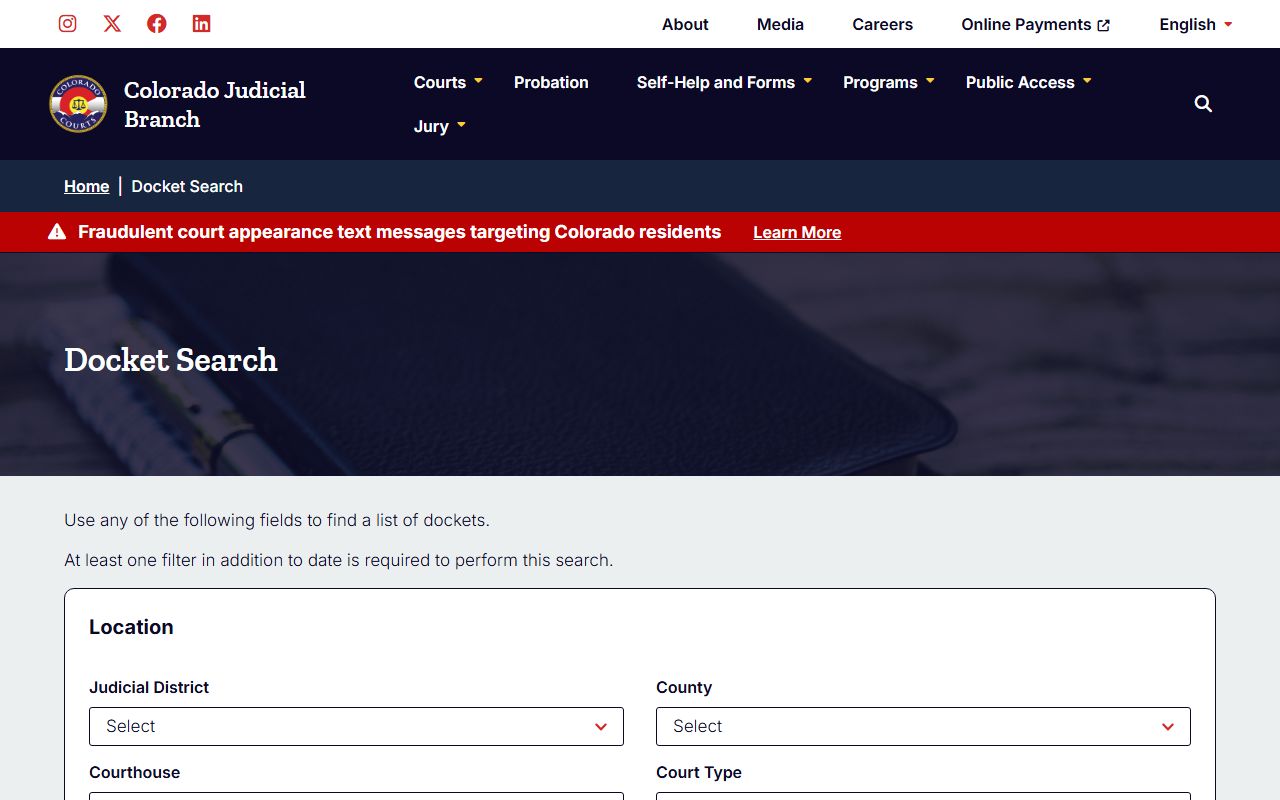
Once a matching docket is found, use the court's document request route for copies rather than treating the docket screen as the full file.
Larimer County Docket Search Fields
Colorado's docket search has many fields, but at least one filter in addition to date is usually needed. Larimer County court records after an arrest are often easier to find when a jail profile has a court case number or when the booking report gives a precise arrest date and name. If the online docket entry is unclear, the Judicial Branch access guide says to contact the court where the original record was created or filed.
| Field Label | Type | Required | Notes |
|---|---|---|---|
| Judicial District | Dropdown | No | Colorado districts are listed. Larimer County is in the 8th Judicial District. |
| County | Dropdown | No | Choose Larimer County for local cases. |
| Courthouse | Dropdown | No | Includes Larimer County Justice Center and Loveland County Court. |
| Court Type | Selection | No | Both, County, or District. |
| Date Range | Dropdown | Yes with another filter | Options include six months, three months, one month, one week, today, or a specific date. |
| Case Class | Dropdown | No | Criminal-relevant classes include CR, M, T, R, and sometimes JD. |
| Party First / Last Name | Text | No | Use DOB from jail records separately when requesting documents. |
| Attorney Name or Bar Number | Text | No | Useful when the attorney is known. |
Charges Filed After Arrest
A jail booking charge is not always the charge that remains in court. The booking record may be based on the arresting agency's information, a warrant, or an initial hold. The prosecutor reviews the case and files the formal charging document. That charging document is what starts or shapes the court case after a Larimer County jail arrest.
| Document | Who files it | Common use | What to request |
|---|---|---|---|
| Complaint | Prosecutor or charging authority | Many criminal cases, including misdemeanor or initial filings | Complaint/Information from court records request. |
| Information | Prosecutor | Many felony cases after charging review | Complaint/Information and Register of Action. |
| Indictment | Grand jury | Grand-jury case, often serious or complex allegations | Indictment if public and not sealed. |
The Judicial Branch record/document request form includes criminal document choices for Complaint/Information, Disposition/Sentence Order, Protection Order, and Ticket. It also lists Register of Action, or ROA, as a brief case explanation that can include charges, sentences, and minute orders. The form asks for contact data, case number, case type, year filed, county or location, date of birth if known, party details, and other identifying information.
Charge Status in Court Records
Larimer County court records after a jail arrest should be read by charge status, not just by the first charge label seen on the roster. A charge can be pending, amended, reduced, dismissed, or resolved by plea, trial, or sentence. The jail profile can include resolved fields for jail-system items, but the court and prosecutor records control the formal case result.
| Status | What It Means | Why It Matters |
|---|---|---|
| Pending | The charge has not reached final disposition. | Court dates, bond, and conditions may still change. |
| Amended | The prosecutor or court changed the charge text, level, or count. | The filed charge may differ from the jail booking charge. |
| Reduced | The charge was lowered to a lesser offense or level. | Often appears after plea negotiation or review. |
| Dismissed | The charge was not pursued or was terminated. | A dismissed charge is not a conviction. |
| Disposition | The final outcome of the charge or case. | Use court records, not LCSO charge summaries, for this result. |
Bond After Larimer Arrest
Bond can appear in both jail records and court records. Larimer's bond page says bonds can be posted 24 hours a day. If the bond type is unknown, the county directs users to look up the inmate online. The roster can provide the inmate number and jail ID needed for online posting. Cash bonds may be posted at the jail entrance kiosk, online or by phone through AllPaid / GovPayNow, or at the release window using money orders or cashier's checks. Ordinary checks are not accepted.
| Bond Type | How It Works | Record Caveat |
|---|---|---|
| PR / Personal Recognizance | Release based on a signed promise or conditions. | Money may become due if the person fails to appear. |
| Cash / Cash-Surety | Full amount paid by cash, cashier's check, or credit card. | Funds may return only if court conditions are met. |
| Surety Bond | Posted through a licensed bail bond agent. | Agent fees are generally non-refundable. |
| No-bond or non-releasable | Payment alone will not release the person. | Holds or court orders may block release. |
A bond amount on a Larimer County record is not a guarantee of release. Holds for other jurisdictions, DOC, parole, federal matters, or court conditions can keep someone in custody. Larimer also warns that scammers use public booking data to call families and demand payment for early release or added charges. Real government agencies do not demand untraceable payment by gift cards, cryptocurrency, Zelle, Venmo, PayPal, or wire transfer.
Warrants and Court Records
No separate official searchable active-warrant database was found on Larimer County Sheriff's Office pages during the research pass. The sheriff quick-links page says warrant information goes through (970) 498-5100, option 5. The Most Wanted page is official and may show fugitive names and photos, but it is a curated public-safety list, not a complete warrant index.
A warrant arrest may appear in the jail booking report after the person is booked. Jail profile fields can show authority as Warrant, plus a warrant or docket number, court case number, bond type, and bond amount. A warrant does not mean the person is currently in jail. Current custody still has to be confirmed through the roster or jail phone line.
Charges Versus Convictions
Being arrested, booked, or charged is not the same as being convicted. This distinction is central to Larimer County court records after a jail arrest. A charge is an accusation moving through court. A conviction is a guilt finding or plea accepted by the court. Court records may show both, but they should not be treated as the same stage.
| Point | Charge | Conviction |
|---|---|---|
| Stage | Accusation after arrest and charging review. | Final or accepted guilt outcome. |
| Source | Complaint, information, indictment, docket, or jail charge field. | Disposition, plea, verdict, sentence order, or Register of Action. |
| Can change? | Yes, charges may be amended, reduced, or dismissed. | Changes usually require court action, appeal, post-conviction process, sealing, or other legal order. |
| Use in screening? | Must be handled carefully and legally. | Still subject to FCRA and other screening rules when used for covered purposes. |
Sealed and Expunged Records
Colorado court and criminal-justice records can be restricted by statutes, court rules, court orders, juvenile protections, victim protections, or ongoing-investigation limits. Sealing and expungement are not the same. A sealed record is hidden from ordinary public view, but may still be available to limited agencies or under court rules. Expungement is stronger and is often used in narrower settings, especially certain juvenile or eligible records.
| Point | Sealed | Expunged |
|---|---|---|
| Public visibility | Removed from ordinary public access. | Treated as erased or unavailable in a stronger way, when law allows. |
| Government access | Some courts or agencies may retain limited access. | Access is more restricted and depends on the record type. |
| Common route | Court petition or statutory process. | Specific statutory process, often narrower than sealing. |
| Effect on jail records | May require separate records handling. | Does not justify relying on third-party sites for legal status. |
Court Records Access Law
Colorado public-record rules are split by record type. CORA, C.R.S. 24-72-201 et seq., is the general public-records law. CCJRA, C.R.S. 24-72-301 et seq., governs criminal justice records such as arrest, booking, law-enforcement, and criminal-justice agency records. Colorado Judicial Branch public access is also governed by court rules, including CJD 05-01 and P.A.I.R.R. 2.
The Colorado Judicial Branch public records access guide explains that vendor register data is not the official court record and may not represent all cases or case types. Copies must be obtained from the individual court or through the Judicial Branch request process. The successful capture of that guide is a good reminder that online docket data is a pointer, not the full record file.
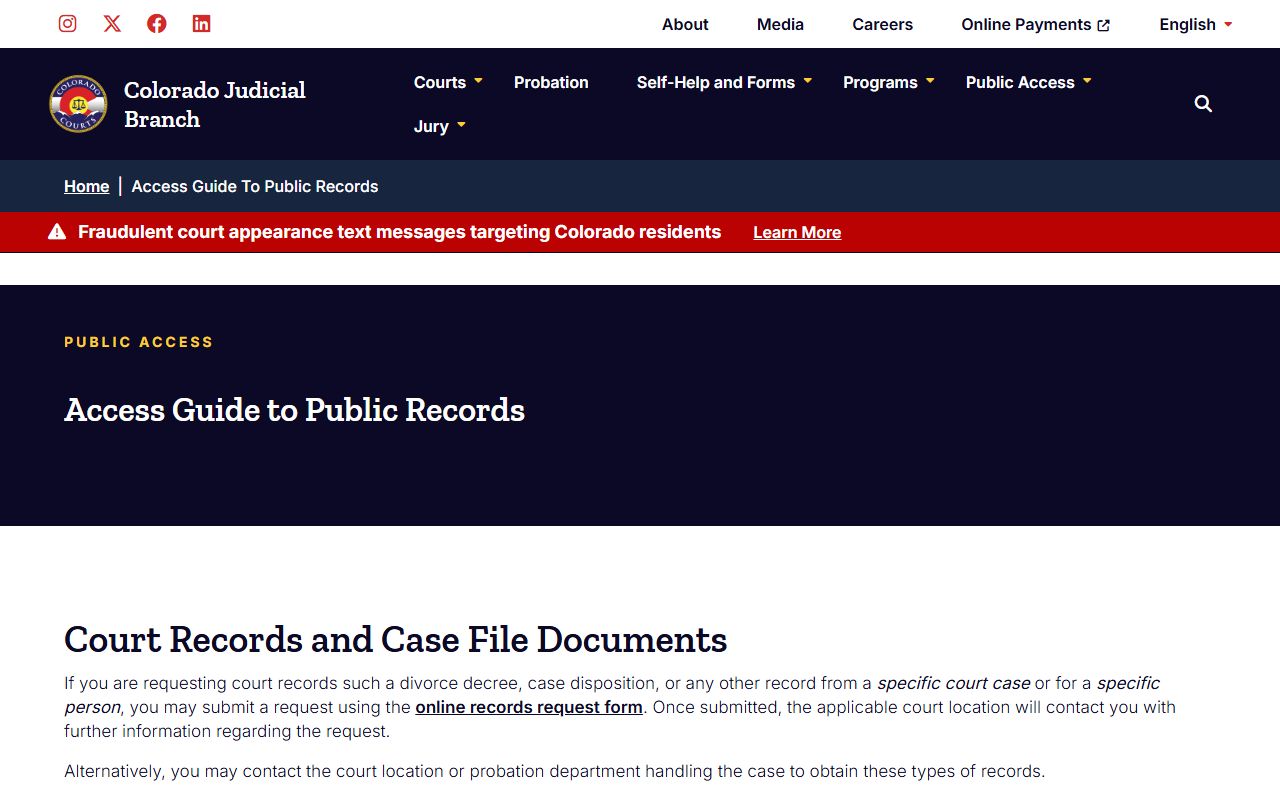
That distinction is important in Larimer arrest cases because the online docket can point to a case while the official documents still come from the court.
Larimer County DA Handoff
The Sheriff's Office records page gives an important local routing rule. If a requester seeks LCSO reports categorized as felony, misdemeanor, or DUI, the event occurred on or after December 1, 2019, the case status is charges filed, and the case is still active in court, the request must go to the Larimer County District Attorney's Office. That is a prosecutor-record handoff, not a jail roster search.
The DA's Fort Collins office is at 201 LaPorte Ave., Suite 200, Fort Collins, CO 80521, with main phone (970) 498-7200. The Loveland office is at 810 E. 10th St., Suite 21, Loveland, CO 80537, with phone (970) 619-4410. The DA page links court docket search, case tracking summary, virtual courtroom links, records request, victim services, and defendant resources. Victim notification for custody status is separate and can use Larimer VINE/COVINE or VINELink.
Important: Court records after a jail arrest can change quickly. Verify active charges, settings, and dispositions with the court or DA.